
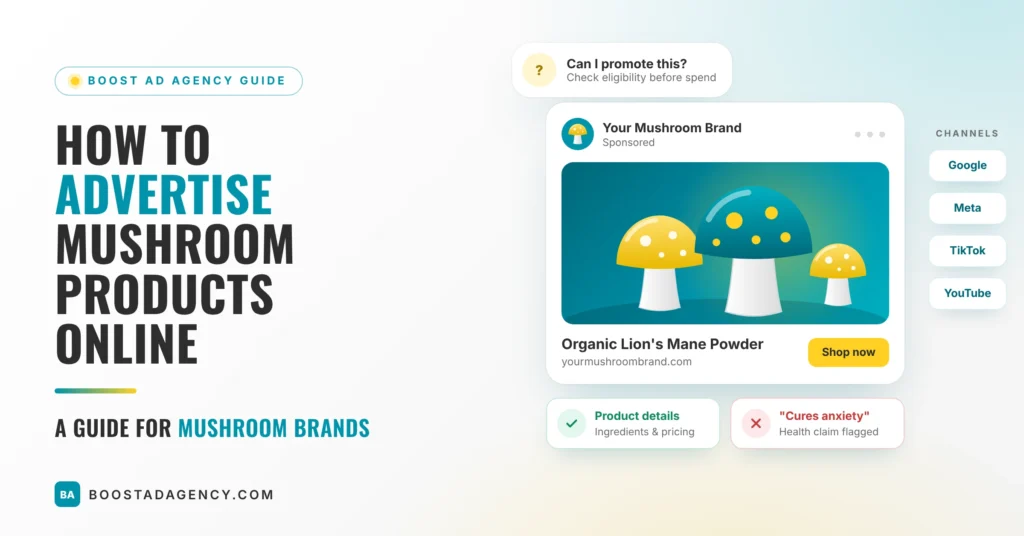
How to Advertise Mushroom Products Online: A Guide for Brands
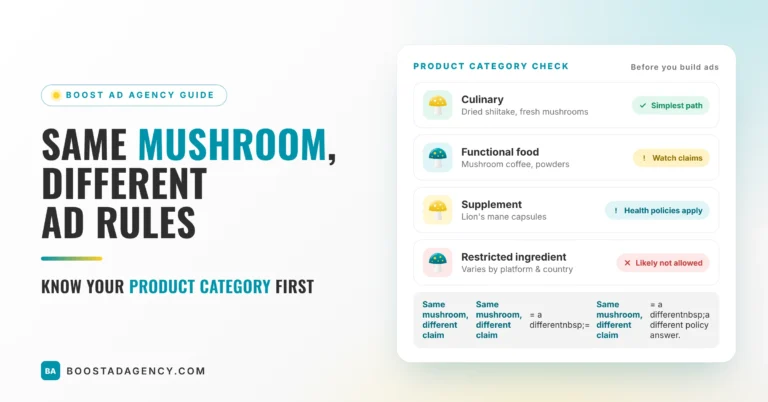
“Mushroom products” could mean a bag of dried shiitake, a lion’s mane powder, a mushroom coffee, or a bottle of capsules. Ad platforms see those as very different things, and your plan should too.
Before spending a cent on ads, ask the boring question first: will this platform let me promote this product at all?
Why mushroom ads get complicated
What’s allowed depends on the ingredient, what the product is for, the claims you make and the country you sell in. Something that sails through as a cooking ingredient can get flagged once it’s pitched as a wellness supplement. Same mushroom, different claim, different answer.
The same few problems come up again and again. Some ingredients are restricted outright. Health claims go out with nothing to back them up. Product pages skip basic details, like what’s actually in the tin. Landing pages promise one thing while the ad says another. And since every platform keeps its own rulebook, getting approved on one tells you very little about the next.
My advice is simple, if a bit dull. Write down exactly what you sell, then read the policies that touch it. That’s an afternoon, and it can save you weeks of disapprovals.
Where mushroom brands can advertise
Google Ads is useful for catching people who are already searching. The catch is eligibility, so check Google’s healthcare and restricted-product policies against your product before you build anything around it.
Facebook and Instagram work well for discovery and getting your brand remembered. Meta limits claims and targeting for health-related products, so read the rules for your category first.
TikTok and YouTube suit short video that shows what the product looks like and why someone might want it. Paid promotion on both still follows each platform’s restrictions.
No channel will take every mushroom product, so plan as if some of yours might get turned down.
Planning your ads
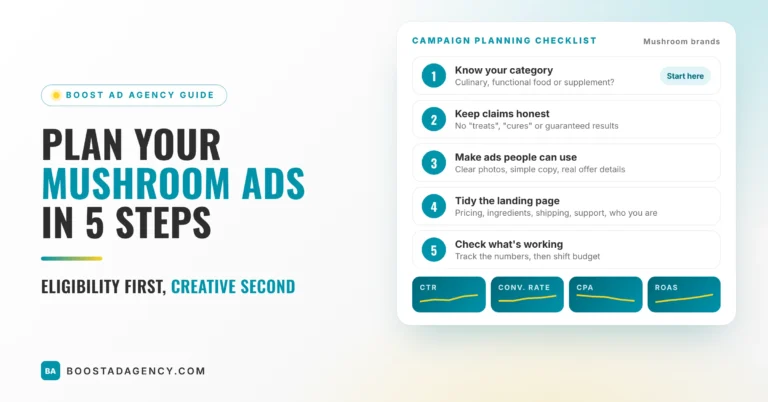
Start from eligibility. Creative and budget can wait.
- Know your category. Culinary, functional food, supplement, or something with a restricted ingredient? That one answer decides which policies you’re dealing with.
- Keep claims honest. Say what’s in the product and what it does, in plain words. Don’t say it treats a disease, cures a condition, or guarantees a health result. If you wouldn’t show the sentence to a regulator, cut it.
- Make ads people can use. Clear photos, simple copy, and real details about the offer beat big promises. Shoppers can tell the difference, and they can decide for themselves.
- Tidy the landing page. Put pricing, product details, who you are, shipping terms, and a way to reach support on it. It has to match what the ad promised, because a mismatch is one of the quickest ways to get flagged.
- Check what’s working. Click-through rate, conversion rate, cost per acquisition, and return on ad spend will show you where to put your effort next.
Where an agency fits
A specialist can check whether a campaign is eligible, review your copy, fix landing pages, and set up tracking so you’re not guessing.
At Boost Ad Agency, content about restricted-niche advertising should emphasize realistic campaign planning, policy awareness, and measurable marketing objectives.
No agency can guarantee approval for a product that breaks a platform’s rules. If one says it can, that’s your cue to look elsewhere.
For some background, Wikipedia has pages on mushrooms and dietary supplements.
How Mushroom Brands Can Advertise on Google and Social Media
Cluster 1: Eligibility
Can you advertise mushroom products on Google?
Yes, some mushroom products can be advertised on Google, but not all. Eligibility depends on four things:
- Ingredients: some mushroom compounds are restricted or banned under Google’s Healthcare and medicines policy.
- Classification: a food, a supplement and a functional product are each treated differently. The FDA explains how dietary supplements are regulated.
- Claims: what you say the product does.
- Policies: Google’s rules plus the laws where you advertise.
Check all four before you spend on ads.
Can mushroom brands use social media ads?
Yes, many mushroom brands can run social media ads if the product and the campaign meet that platform’s rules. Meta, TikTok and Pinterest each have their own policies, so read the rules for your product category on each platform before you launch.
Cluster 2: Ad rejections
Why do mushroom ads get rejected?
Most mushroom ads are rejected for one of four reasons:
- Restricted ingredients in the product.
- Unsupported health claims, such as promising a cure or a guaranteed result. The FTC’s health products compliance guidance explains what counts as a supported claim.
- Misleading wording that exaggerates what the product does, which breaks Google’s Misrepresentation policy.
- Landing page problems, where the page breaks policy or contradicts the ad. See Google’s Destination requirements.
Fixing these issues before you submit is quicker than appealing a rejection.
Cluster 3: Launch preparation
What should a mushroom brand do before launching ads?
Confirm the product category and eligibility first, then review your landing page and ad claims. A quick checklist:
- Define exactly what the product is and how it’s classified.
- Confirm it’s allowed on each platform and in each country you’re targeting.
- Remove any claim you can’t back up with evidence.
- Make sure the landing page matches the ad and meets the platform’s policies.
Conclusion
Mushroom brands do better when they know exactly what they sell, stay honest about what it does, and take the rules seriously. That means sorting your products by type, checking each one against the platform’s policies and local laws, and cutting any claim you can’t back up.
Compliance won’t make every product eligible. Some items will stay off the table no matter how carefully you word the ad. For the ones that are eligible, though, it’s the best base for campaigns that last. Clear copy, matching landing pages and accurate labels mean fewer disapprovals, fewer account warnings and more trust from the people who click.
Get the groundwork right first, and every campaign you run after that has a much better chance of staying live and paying off.
Written by Boost Ad Agency Team
Boost Ad Agency specializes in paid advertising, e-commerce, ad approvals, and restricted-niche campaigns across Google, Meta, TikTok, YouTube, Pinterest, and Snapchat. The team works with industries including peptides, CBD, crypto, healthcare, forex, and other restricted markets, with experience in campaign management, compliance, and scaling.
Related Blogs
Just Schedule a Call or Fill the Inquiry Form!!