
Small Business Ad Budget: How Much Should You Spend?
“Right, so how much do we need to spend?” Nine times out of ten that’s the first proper question a small business owner asks us. And nine times out of ten our first answer is “well, it depends”, which I know sounds like a dodge.
It isn’t, though. There just isn’t one number that works for a florist, a dentist and a candle shop. What there is, is a way of working out your number, and that’s what I’ll walk through here. It’s the same approach we use when we’re setting a small business ad budget with a new client, whether they sell online or run a local service.
How much should a small business spend on ads?
Enough to run a fair test for two or three months without making payroll stressful. That’s the honest floor. The figure itself should come from what a new customer is worth to you, and you only push it higher once ads are clearly bringing customers in at a profit.
You’ll bump into rules of thumb online, usually some percentage of revenue. They’re fine for a rough sanity check. The trouble is they ignore your margins, your prices and how crowded your corner of the market is. A bakery and a SaaS company really shouldn’t be using the same maths.
If the basics of how you get charged are a little hazy, Wikipedia’s page on pay-per-click explains the model nearly every ad platform uses. You pay when someone clicks. More advertisers chasing the same people means pricier clicks.
How do you set your small business ad budget?
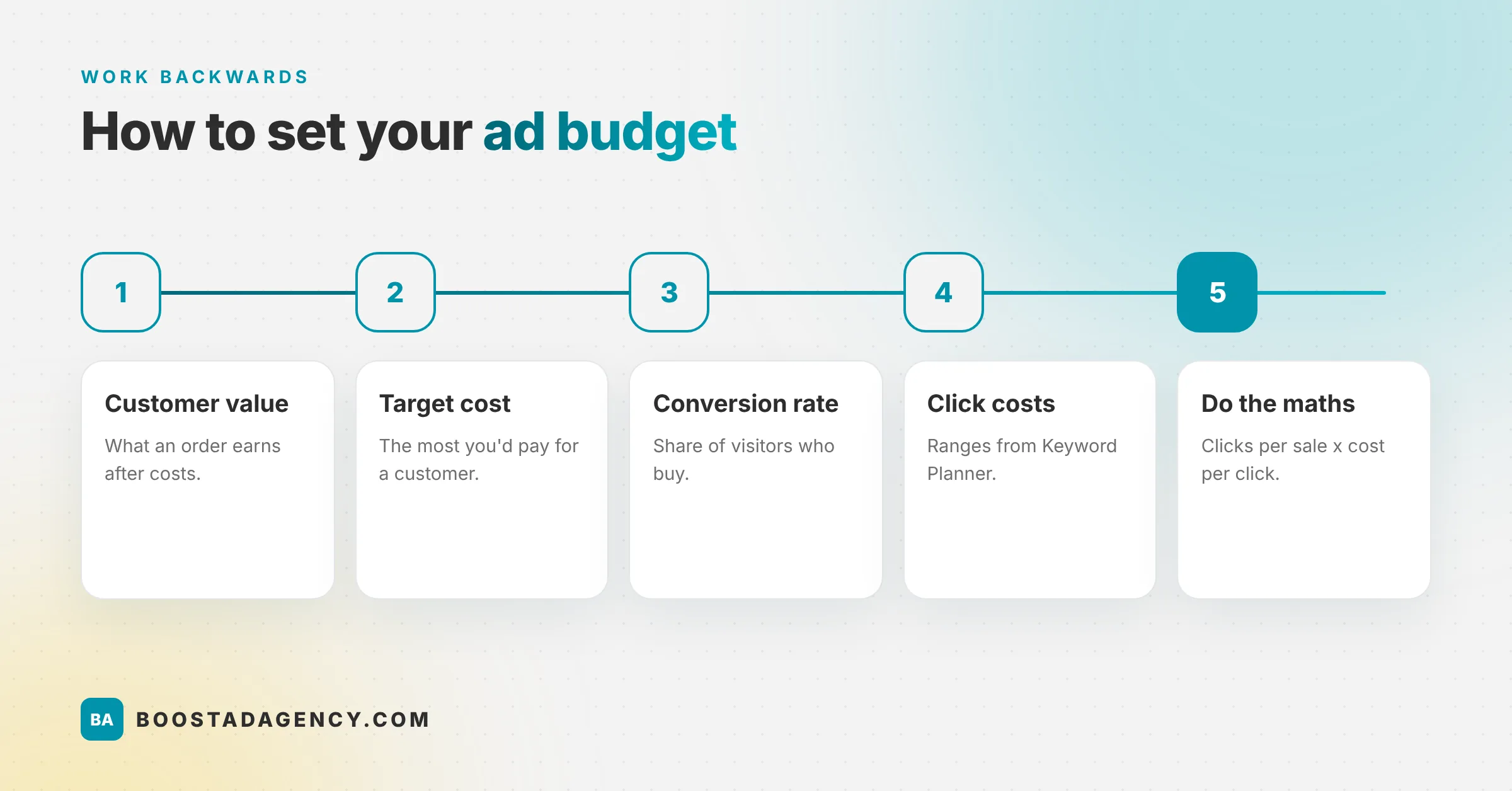
Start from your own numbers and work backwards. What’s a typical customer worth? How much of that would you happily hand over to win one? About how many clicks does it take before someone buys? Put those three together and you’ve got a test budget. Not perfect. Good enough to start.
Customer value first. What does an average order leave you with after costs? If people come back and buy again, count some of that. Then pick a target cost per customer, basically the most you’d pay for a new one and still be pleased about it. Next, check your conversion rate in your analytics, meaning what share of visitors actually buy. No data yet? Assume it’s low. It usually is at first.
Last piece is click cost. Google’s Keyword Planner will give you a rough range for searches in your area. Multiply clicks-per-sale by cost-per-click and you’ve got a ballpark cost to win a customer.
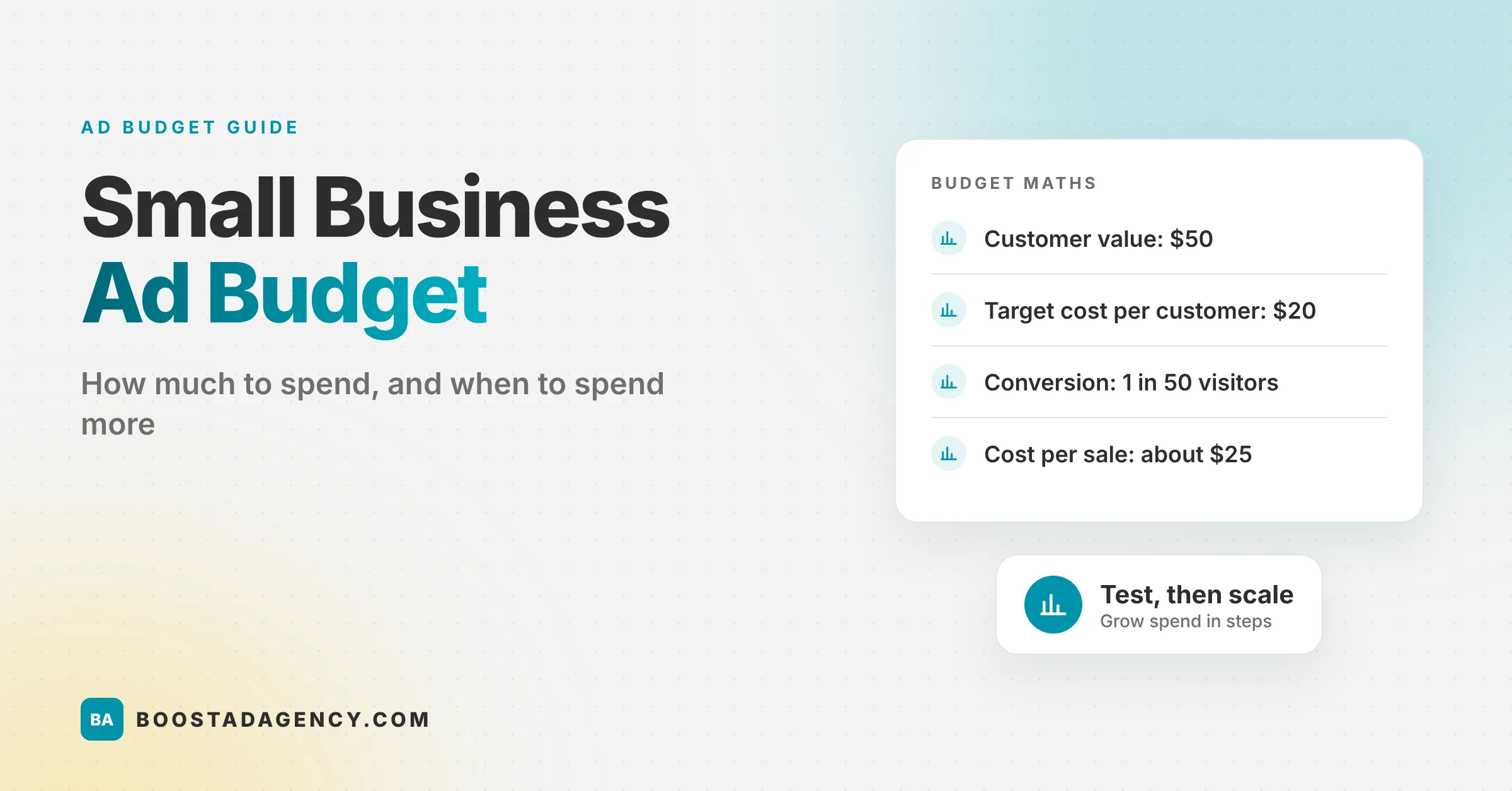
Here’s a made-up example with nice round numbers. An order makes you $50 after costs, and you’d happily pay $20 for a new customer. Your site converts one visitor in fifty. Clicks cost around fifty cents. So each sale costs you about $25 in clicks. That’s over your limit, and it tells you something useful: before spending more, improve the site, sharpen the offer or go after cheaper searches.
How do daily budgets work on Google Ads?
You set an average daily budget for each campaign. Busy days, Google might spend a bit over. Quiet days, less. Across a month, though, it won’t bill you more than that daily figure times the average number of days in a month.
That catches people out all the time. Google’s help article on how to set an average daily budget spells it out: on any single day spend can go up to twice your daily budget, but the monthly cap still holds. So a $20-a-day campaign comes to roughly $608 a month. Not exactly $20 every day, which confuses people when they look at their bill.
Google also has a broader article on managing your spend. Ten minutes with that before your first campaign goes live is time well spent.
Which platform should a small budget start on?
Wherever your customers already go looking. If people search for what you sell, Google search or Shopping is usually the place to start. If your product is something people stumble on and fall for, Meta or Pinterest can be the better bet. Splitting a small budget across four platforms tends to mean none of them gets enough data to learn anything.
Plumbers, physios, clinics and other local services usually do best kicking off on Google search. Online shops often get a lot out of Shopping, and our Google Shopping ads guide covers that setup. Home, fashion and lifestyle brands frequently find Pinterest and Meta great for reaching people before they’ve even started searching, which is the whole idea behind our Pinterest ads service Pick one. Give it a proper run, a couple of months if you can. Then decide whether a second platform is worth it.
One more thing on platforms. Seasonality matters more than people think. A garden centre’s Google costs in April look nothing like its costs in November, and a gift shop’s December is its own planet. If your business has busy and quiet months, plan the budget around them rather than spreading the same amount evenly across the year. Put more behind the weeks when people are actually buying, and use the quiet stretch to test new ads cheaply.
When should you change or increase the budget?
Not after three days. New campaigns need a few weeks and a decent amount of data before the platform figures out who responds. Small tweaks along the way are fine. Doubling or halving spend because of one bad Tuesday usually isn’t.
Have a scroll through r/smallbusiness and you’ll find no shortage of owners who switched ads off after a week because “it didn’t work”. Sometimes they were right. Often the campaign just never got enough time or money to show what it could do.
Once it does work, meaning customers are coming in at a cost you’re happy with and you’ve got capacity for more, raise the budget in steps. Watch whether cost per customer holds. If it jumps, ease off and figure out what changed. Signs you’re ready to grow: costs steady for several weeks, campaigns regularly hitting their daily cap, and the stock or staff to handle more. Signs you’re not: patchy tracking, or a website that leaks visitors. Fix those first, because extra budget only makes a leak bigger.
Conclusion
Key Takeaways
- Base your small business ad budget on what a customer’s worth to you, not a generic percentage.
- Work backwards from customer value, conversion rate and click costs.
- Google’s daily budget flexes from day to day but has a monthly ceiling.
- Start on one platform where your customers already look.
- Give it weeks, not days, then grow spend in steps.
The right budget is one you can afford to test with and build on. Know your numbers, start in one place, be a bit patient, and scale when the results say so. If you’d like a hand planning your first campaign, get in touch with our team
Written by Boost Ad Agency Team
Boost Ad Agency specializes in paid advertising, e-commerce, ad approvals, and restricted-niche campaigns across Google, Meta, TikTok, YouTube, Pinterest, and Snapchat. The team works with industries including peptides, CBD, crypto, healthcare, forex, and other restricted markets, with experience in campaign management, compliance, and scaling.
Related Blogs
Just Schedule a Call or Fill the Inquiry Form!!